In this final part of the practical session, you will implement a complete compressible gas dynamics solver using the Euler equations. This builds upon everything you have learned: mesh creation, field manipulation, flux computation, and adaptive mesh refinement.
The Euler equations describe the motion of inviscid (non-viscous) compressible fluids. They are fundamental in aerodynamics, astrophysics, and shock physics. Unlike Burgers, the Euler system couples four conservation laws (mass, momentum in x and y, energy), requiring more sophisticated numerical schemes.
Euler equations
The Euler equations in 2D read:
where:
is the density (mass per unit volume)
are the velocity components in x and y directions
is the total energy per unit volume (where is the specific total energy)
is the pressure
where is the specific total energy (energy per unit mass), with the internal energy per unit mass.
The pressure is given by the equation of state for an ideal gas:
where is the ratio of specific heats (typically 1.4 for air).
Sound Speed
The sound speed (or speed of sound) is defined as:
Physical meaning: This is the speed at which small pressure disturbances (acoustic waves) propagate through the fluid. It is crucial for:
Determining the time step (CFL condition)
Estimating wave speeds in Riemann solvers
Identifying supersonic vs subsonic flow regimes (Mach number )
Explanation of the provided code
The Euler code becomes more complex due to the number of equations and the coupling between them. To save time, we provide you with starter code that you can find in the euler folder. We will now explain the different parts of the code that will help you in the next steps.
The configuration of the mesh and fields is defined in config.hpp.
Naming convention of the variables
We have defined the numbering of the components of the vector field as follows:
Component 0: (density)
Component 1: (total energy per unit volume)
Component 2: (momentum in x)
Component 3: (momentum in y)
Once you have created the vector field conserved containing the conservative variables, you can access each component using:
// For cells
conserved[cell][EulerConsVar::rho]
conserved[cell][EulerConsVar::rhoE]
conserved[cell][EulerConsVar::mom(d)] // d = 0, 1 for x, y

// For intervals
conserved(EulerConsVar::rho, level, i, j)
conserved(EulerConsVar::rhoE, level, i, j)
conserved(EulerConsVar::mom(d), level, i, j)
Conversion between conservative and primitive variables
Next, you need to be able to convert the primitive variables from the conservative ones and vice versa. The primitive variables are:
(density)
(velocity in x-direction)
(velocity in y-direction)
(pressure)
where the notation and represent the momentum components.
The functions cons2prim and prim2cons defined in variables.hpp allow you to convert between these two sets of variables.
Equation of state
The object eos defined in eos.hpp allows you to compute the pressure and sound speed from the primitive variables. Here is an example of its usage:
auto p = eos::stiffened_gas::p(rho, e);
auto c = eos::stiffened_gas::c(rho, p);
auto e = eos::stiffened_gas::e(rho, p);
where e is the internal energy per unit mass.
Time step computation
For explicit time integration, the CFL condition must be satisfied:
where the maximum is taken over all cells. A default value is set to in the main function. We provide the get_max_lambda function in utils.hpp that computes the maximum wave speed in the domain:
auto get_max_lambda(const auto& u)
{
    static constexpr std::size_t dim = std::decay_t<decltype(u)>::dim;
    double res                       = 0.;

    const auto& mesh = u.mesh();

    samurai::for_each_cell(mesh,
                           [&](const auto& cell)
                           {
                               auto prim = cons2prim<dim>(u[cell]);

                               auto c = EOS::stiffened_gas::c(prim.rho, prim.p);
                               for (std::size_t d = 0; d < dim; ++d)
                               {
                                   res = std::max(std::abs(prim.v[d]) + c, res);
                               }
                           });
    return res;
}
Numerical schemes
We propose implementing three different schemes for the Euler equations: Rusanov, HLL, and HLLC. Each of these schemes is described below.
Rusanov scheme
The Rusanov scheme is a simple and robust approximate Riemann solver. The flux function for the Rusanov scheme can be defined as follows:
where is the maximum wave speed in the direction normal to the interface.
where and are the sound speeds on the left and right states.
HLL scheme
The HLL (Harten-Lax-van Leer) scheme is another approximate Riemann solver that considers only the fastest left-going and right-going waves. The flux function for the HLL scheme is given by:
where and are the estimated speeds of the left-going and right-going waves, respectively.
HLLC scheme
The HLLC (Harten-Lax-van Leer-Contact) scheme is an extension of the HLL scheme that also captures the contact discontinuity. The flux function for the HLLC scheme is more complex and involves additional wave speed estimates.
Contact wave speed
The contact wave speed (also called star region velocity) is computed as:
Star region states
Let’s introduce the intermediate states and in the star region. We first compute the density in the star region:
where .
The velocity components in the star region remain the same as in the original state, except for the normal velocity which is set to .
The fourth component (total energy per unit volume) in the star state is:
where is the specific total energy.
Thus, for the x-direction flux, the star region states are given by:
and for the y-direction flux, they are given by:
Star region fluxes
The fluxes in the star region are computed as:
Final HLLC flux
The HLLC flux is then given by:
This four-wave structure allows the HLLC scheme to resolve contact discontinuities more accurately than the HLL scheme while maintaining robustness.
Initial conditions
The physical domain is . The initial condition consists of a Riemann problem with four constant states separated by discontinuities:
The boundary conditions are homogeneous Neumann conditions.
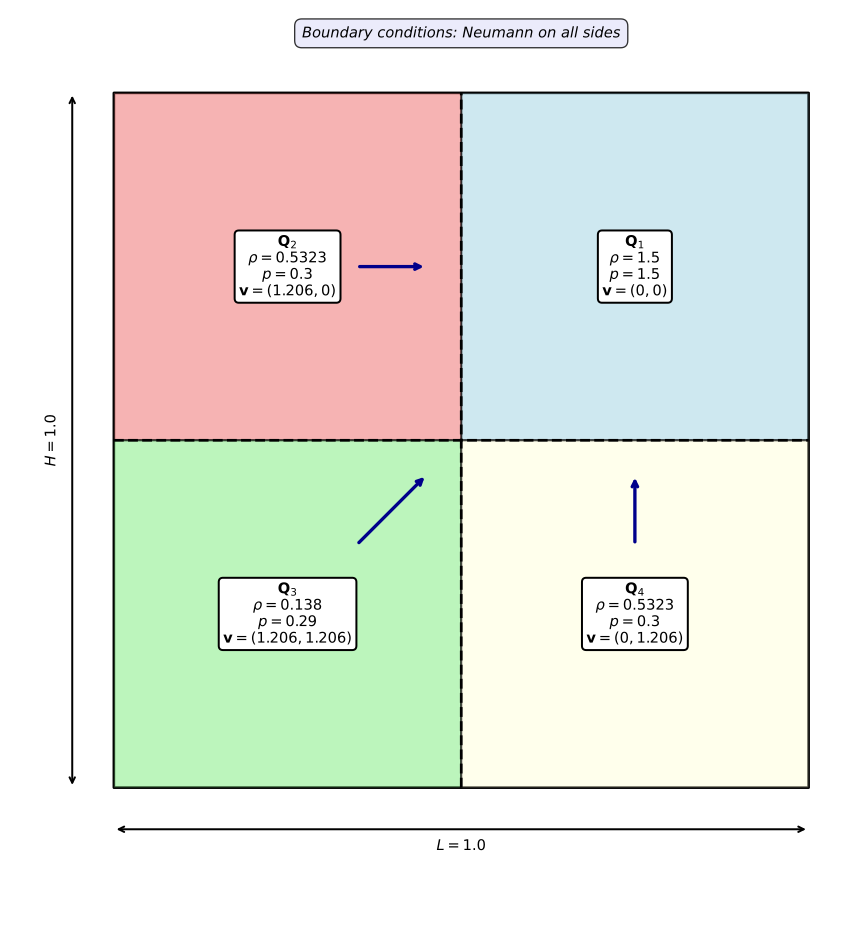
The initial condition is provided in the initial_condition.hpp file.
Exercises
To implement and simulate the Euler equations in 2D using samurai, you will need to follow the steps introduced in the previous sections. Here is a summary:
Set the dimension of your problem
Create a mesh
Create a vector field with 4 components (density, x-momentum, y-momentum, energy)
Define the initial condition
Define the flux functions for the three schemes presented (Rusanov, HLL, HLLC)
Create the time loop and apply the scheme at each time step
Visualize the results using ParaView
If everything is working correctly, you can add adaptive mesh refinement using the multiresolution capabilities of samurai.
Conclusion
In this first part on the Euler equations, you have successfully implemented a complete solver for compressible gas dynamics. You learned to:
Understand the coupled system of conservation laws (mass, momentum, energy)
Work with primitive variables (, , ) and conservative variables (, , )
Implement three Riemann solvers with increasing sophistication:
Rusanov: Simple and robust, but dissipative
HLL: Better resolution of contact discontinuities
HLLC: Accurately captures all wave structures (shocks, contacts, rarefactions)
Apply adaptive mesh refinement to efficiently resolve shocks and flow features
Visualize complex multi-dimensional gas dynamics phenomena
In Part 2, you will tackle an even more challenging problem: the double Mach reflection. This classical benchmark will require you to implement custom boundary conditions (reflecting walls, inflow/outflow) and develop a robust prediction operator to maintain physical positivity during mesh adaptation. This next step will demonstrate how samurai’s flexible framework can handle complex, realistic shock physics problems.